

Samuel Hyde maps the merging of the radical Left’s ideology with Islamism and its lionisation of Iran’s Islamic revolution arguing that the demonstrations after Khamenei’s death and the pledges of allegiance to the Iranian regime represent the continuation of this intellectual inheritance.
ALL EYES ON KHAMENEI
The U.S.–Israeli strike that killed Ayatollah Ali Khamenei, along with several other leaders of the Iranian regime, set off notably different reactions. For millions of Iranians, Khamenei had long symbolised suffocation: prisons filled with dissidents, crushed protests, executions, and mourning mothers. When news of his death spread, the reaction in many Iranian cities was relief. People danced. Cautiously, they allowed themselves to breathe.
The reaction to Khamenei’s death did not unfold in a single moral register. A very different response began to organise itself, methodically, thousands of miles away. Within twenty-four hours, the ANSWER Coalition began coordinating protests across the United States under the banner ‘Stop the War on Iran!’ Demonstrations took place in fifty-five cities on March 2, 2026 with plans for ‘international expansion underway.’
The People’s Forum, a professional activist organisation and ‘a home’ for over 200 left-wing groups in Manhattan, described as an ‘incubator’ for ‘the working class,’ ‘internationalism,’ and ‘movement building’ moved just as quickly to frame the narrative. Its message has been unequivocal: ‘the greatest source of chaos in the Middle East isn’t Iran – its U.S. imperialism and Zionism!’ Also present at the demonstrations were CODEPINK, a feminist organisation known for its ‘anti-imperialist campaigns,’ and the Party for Socialism and Liberation, a self-proclaimed American revolutionary Marxist party.
The self-proclaimed left of Jewish politics in the United States was also implicated. The National Iranian American Council (NIAC), which has acted as a lobby for the Iranian regime in the United States, issued a statement declaring the war ‘a betrayal’ of ‘American voters,’ and claimed that its true aim was ‘to fulfill Benjamin Netanyahu’s vision of ruling over the rubble of the Middle East.’ J Street, which describes itself as ‘the political home and voice for pro-Israel, pro-peace, pro-democracy Americans’, has cooperated with NIAC.
Part of the radical Left that is now in power spoke up for the interests of the Iranian regime. The Democratic Socialists of America (DSA) – the party of New York City Mayor Zohran Mamdani – issued a statement entitled ‘DSA Stands against Imperialist War and with the Iranian People.’ DSA described the joint U.S.–Israeli operation as ‘a continuation of the hybrid war that has been waged against Iran since its popular revolution in 1979.’ It is worth recalling that on October 8, 2023, the day after the Hamas attack on Israel, DSA members rallied under the banner ‘resistance is justified when people are occupied’, and walked through the streets of New York chanting ‘700,’ the first reported Israeli death toll from the Hamas massacre the day before.
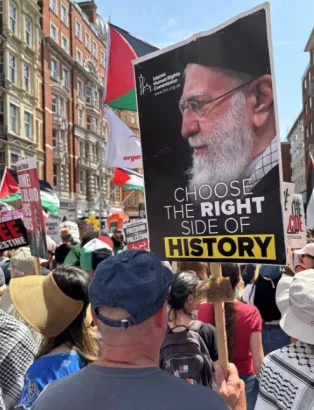
There were similar sentiments from the radical Left in the U.K. In a statement addressed to prime minister Keir Starmer, Your Party, an alliance of Islamists and leftists, declared that ‘the unprovoked attack on Iran by the United States and Israel is a war of aggression that endangers us all.’ One founder of Your Party is Jeremy Corbyn, a former leader of the Labour Party whose tenure was marked by an upsurge of antisemitism. On March 7, 2026 thousands of pro–Iranian regime demonstrators marched through central London chanting anti-Israeli and anti-American slogans while holding placards bearing Khamenei’s face and the words ‘Choose the Right Side of History.’ Speaking to the crowd, Zarah Sultana, a Your Party MP, said ‘Another Labour government, another U.S. president launching an illegal war. Shame on them.’
FEMINISTS FOR PATRIARCHY
Among the protestors in London were women’s rights activists dressed in the crimson robes and white bonnets of The Handmaid’s Tale, the novel published by Margaret Atwood in 1985. The costume symbolises a society in which women’s bodies are regulated by clerical authority. Atwood herself noted that the images of women in black chadors following the Iranian Revolution were among the inspirations for her book.[i] The London protestors, however, inverted the symbolism, turning a costume meant to warn against theocracy into a defence of a theocratic, patriarchal regime.
ROOTS OF REVOLUTION
None of this was surprising. The world has witnessed since October 7 a constellation of organisations and political parties marching en masse through Western capitals, with chants of ‘Long live Hamas’ treated as a natural extension of radical Left politics. Seen in this light, the Iran protests are the latest expression of the alliance between Islamists and today’s anti-imperialists of the radical Left. It is an alliance often described as a marriage of convenience. Islamists are said to manipulate credulous Western leftists who fail to grasp the ideological commitments of their partners. However, this explanation is too charitable.
It was American philosopher Judith Butler who defined the nature of the relationship between Islamists and the radical Left, that it is not an alliance but a common cause. She said in 2006 during a UC Berkeley event that ‘understanding Hamas, Hezbollah as social movements that are progressive, that are on the Left, that are part of a global Left, is extremely important.’ While a week after the October 7 Hamas attacks she condemned Hamas’s violence, she went on to state in March 2024 at a panel in Paris hosted by the New Anticapitalist Party that the massacre was ‘armed resistance,’ ‘not a terrorist attack’ and ‘it’s not an antisemitic attack.’
Much of the outrage at Butler focused on the falseness of her statements. In retrospect, what mattered was not her inaccuracies, but her candour. She articulated the ideology of many in the radical Left, that Islamist movements are legitimate anti-imperial insurgencies and Hamas, a proxy of the Iranian regime, is an armed resistance group. The radical Left that stands for secularism and opposes any hint of religious coercion in the West gives a central place in its world view to Middle Eastern terrorist movements rooted in radical Islamist ideology.
WHAT WENT WRONG?
The radical Left’s incorporation of Islamism began with its identification with Palestinian militants. Jason Burke traces the lineage of these connections in his new book The Revolutionists: The Story of the Extremists Who Hijacked the 1970s. The New Left, as that era’s radicals were known, turned outward. They were disillusioned with Soviet communism and increasingly contemptuous of the working class, which these leftists believed had been absorbed into the welfare state and seduced by capitalist consumerism. The New Left sought what it imagined to be the last remaining reservoirs of authentic resistance to capitalism and the West.
Most of the New Left radicals, along with the militants from the Middle East they encountered, defined themselves as anti-Western. They belonged to one Marxist denomination or another: Maoists, Leninists, Trotskyists, and Fidelists. Despite their apparent rejection of the West, their ideas were built upon a schema incubated entirely within Western thought. Their theories of violence, liberation, and historical destiny bore the imprint of German Romanticism and the revolutionary traditions of France and Russia.[ii] These progenitors of today’s radical Left shared a fully formed worldview and a commitment to radical and irrevocable social transformation with Middle Eastern militants. From this common foundation they sought to forge a transnational network of anti-imperial insurgency and ‘Third World’ solidarity.
Among the notable characters detailed by Burke, is Leila Khaled of the Popular Front for the Liberation of Palestine, best known for her involvement in airplane hijackings in the late 1960s and early 1970s. She has since became an icon of revolutionary chic for the anti-imperial left, her image sporting a soft cap not dissimilar to those popularised by Mao and a keffiyeh is reproduced on posters for radical student movements and communist groups in Europe and the United States. In 2020, Leeds University hosted a panel discussion with Khaled about the importance of transnational resistance.
Middle Eastern militant organisations recognised in the radical Left not merely useful allies, but powerful amplifiers within the cultural capitals of Europe and the United States. The radical Left, in turn, saw in the militants of the Middle East a new revolutionary vanguard. The coming revolution would originate far away, in Asia, Africa, Latin America or the Middle East – places where the masses were ready to rise up and fight against the forces of capitalism, imperialism, and colonialism.
However, this analysis produced a strategic dilemma. The adversary was not a single leader, government, or corporation. It was an expansive global system of political and economic power. Confronted with such a diffuse enemy, it was never clear how a handful of kidnappings, assassinations, or guerrilla training camps could meaningfully bring that system down. That is part of why Israel became their primary target.
The great scholar of conspiracy theory, Jovan Byford, notes that in the 1970s, ‘the far left in Britain and on the continent [Europe] viewed Middle Eastern politics almost exclusively through the prism of Soviet anti-Zionism.’ In 1970, the CIA complained that ‘the Soviets have succeeded in making the New Left anti-Zionist.’[iii]
As Soviet antizionist propaganda networks expanded in the 1960s, many radicals of the period were convinced to regard the Jewish state as a particularly vivid example of what they believed to be capitalist decay and colonial domination. Simultaneously, Israel appeared to them small and vulnerable enough to challenge through acts ‘direct action.’ By embracing antizionism, they imagined they were striking at a pressure point in a corrupt Euro-American ‘imperial order,’ helping to accelerating its unraveling.
Few figures embodied this transformation more clearly than Meinhof, Ulrike Meinhof. With her comrades in the German Red Army Faction she travelled to PLO camps in Lebanon and Jordan, where she trained alongside Arab militants and absorbed the lexicon of armed struggle. Meinhof believed that postwar West Germany was merely fascism in a liberal guise, and that Israel represented the militarised outpost of Western imperialism. For her and her comrades, violence against the Jewish state would awaken the Western masses from their bourgeois complacency. Israel, as a state born from European catastrophe yet aligned with U.S. power, became a symbol of everything the anti-imperial imagination sought to negate.
FROM QUTB TO KHOMEINI
Even as these secular revolutionaries were staging their global revolution, another ideological current was gathering strength in the Middle East. In 1964, Sayyid Qutb, a leading ideologue of the Muslim Brotherhood, published Milestones. In it, he declared contemporary Muslim societies to be sunk in jahiliyya – pre-Islamic ignorance – and called for ‘a vanguard’, in the Leninist sense, to wage jihad against foreign empire and what he termed ‘World Jewry.’[iv] Qutb absorbed elements of anti-colonial rhetoric, but he embedded them within a totalising religious vision and cited Islamic texts. While the Muslim Brotherhood’s opposition to imperialism and Zionism matched that of the secular Arab militants, their proposed alternative was very different. The only solution was an Islamic state.[v]
Qutb’s ideas resonated in a region humiliated by Israel’s stunning military victory in 1967, authoritarian stagnation, and economic failure. The Islamist project expanded. By the mid-to late 1970s, many Middle Eastern Marxists began abandoning imported European ideologies in favour of Islamism that felt indigenous and transcendent. Instead of class struggle, they spoke of divine sovereignty. Their revolutionary zeal remained; the metaphysical horizon changed.
This popularisation of Islamism reached its most consequential expression in the 1979 Iranian revolution. The Islamic Revolution demonstrated the transformative power of the new synthesis. Ruhollah Khomeini spoke of revolution, social justice, and anti-imperialism. He also was well versed in Maoism and the likes of Franz Fanon, but he rooted concepts in Shia theology and clerical authority. He spoke of an ‘Imperialist-Jewish conspiracy’ and condemned ‘Western imperialism’, while urging his followers to ‘export our revolution to the world.’[vi] Khomeini’s language suggested the influence of the leftist ideologies that had made such a mark on the Middle East over previous decades – despite his own visceral contempt for their adherents.
Having not previously admitted the existence of tabaqeh or ‘class’ as an analytic category, Khomeini begun using the concept in his speeches to mobilise the masses. Terms common to Middle East Marxists such as enqelab (revolution), and jumhori (republic), crept in too, as well as a series of familiar binary divisions. ‘The poor were battling against the rich; the inhabitants of the slums against inhabitants of the palaces; the needy against the aristocrats.’[vii] The result of the revolution was more than a change of government. It was the establishment of the Islamic Republic of Iran, a state that fused populism, anti-Americanism, and virulent antizionism with a religious narrative.
The establishment of the Islamic Republic was the main change from the ideological convergence between the radical Left and Middle Eastern militants. Islamists and radical Left intellectuals now were united by a shared conviction that existing power structures could be overturned by force. Michel Foucault, the high-priest of postmodernism, had traveled to Iran as a special correspondent for Corriere della Sera in 1978 on the eve of the revolution. What he encountered there electrified him. For the next few years he wrote glowingly in over 80 articles about Iran’s Islamic revolution in the French press. He believed he was witnessing something that modern political theory had overlooked: a revolution not driven by ‘technocracy’ or ‘western rationalism’, but by what he called ‘political spirituality’. Something powerful enough to ‘overturn the systems of power.’[viii]
The demonstrations after Khamenei’s death, the pledges of allegiance to the Iranian regime and indeed the large antizionist demonstrations over the last two years, are the continuation of this intellectual inheritance. The Western left’s anti-imperialism, vanguardism, disdain for liberal paternalism and redemptive violence was retrofitted to the immutable, unfalsifiable religious narratives of the Middle East. The object shifted from class to civilisation, from bourgeois decadence to jahiliyya, but the structure of thought remained intact. Israel, small enough to be defeated yet symbolically vast enough to embody ‘the system,’ became indispensable in this ideological architecture.
The reluctance to acknowledge this story arises from a familiar reflex: the comforting conviction that the politics of the radical Left are, by definition, the cause of decent people everywhere. Any corruption or violence associated with the radical Left must be the work of a few bad men betraying an otherwise noble revolution – the attitude long applied to mass repression in the Soviet Union.
That reflex does not survive even the most cursory glance at history. The record is unmistakable: the Reign of Terror during the French Revolution, Lenin’s repression of the kulaks, Stalin’s purges, Mao’s ‘Great Leap Forward,’ Fanon’s sanctification of revolutionary violence, and the horrors of the Khmer Rouge. In the light of the radical Left’s ideological merger with Islamism and its lionisation of Iran’s Islamic revolution, its delight at the massacres of October 7 and its mourning of Khamenei make perfect sense.
[i] Faye Hammill, ‘Margaret Atwood: The Handmaid’s Tale’ in A Companion to Science Fiction. John Wiley and Sons, 2005, ed. David Seed, page 522.
[ii] James H. Billington, ‘Epilogue: Beyond Europe’ in Fire in the Minds of Men: Origins of the Revolutionary Faith, Basic Books, 1980, pages 505-509.
[iii] Jovan Byford, Conspiracy Theories: A Critical Introduction, Palgrave Macmillan, 2011, pages 62–65.
[iv] Paul Berman, Terror and Liberalism, W. W. Norton & Company, 2003, page 86.
[v] Jason Burke, The Revolutionists: The Story of the Extremists Who Hijacked the 1970s, Bodley Head, 2025, page 280.
[vi] Paul Berman, Terror and Liberalism, W. W. Norton & Company, 2003, page 109.
[vii] Jason Burke, The Revolutionists: The Story of the Extremists Who Hijacked the 1970s, Bodley Head, 2025, page 377.
[viii] Janet Afary and Kevin B. Anderson, Foucault and the Iranian Revolution: Gender and the Seductions of Islamism, Chicago University Press, 2005, pages 81-85.


