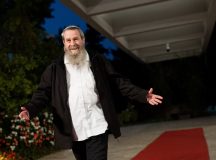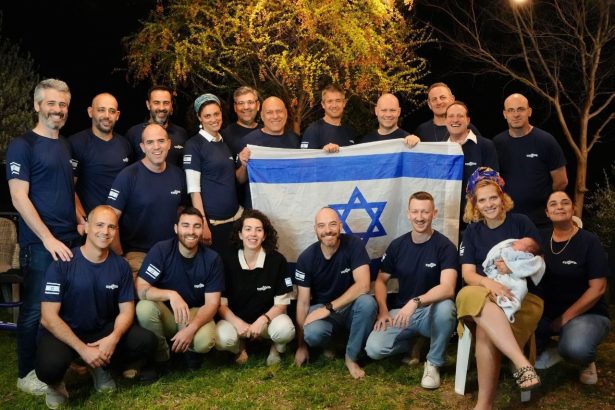

In the darkness of a Gaza hideout following another dangerous mission, Major (Res.) David Sherez[1] sat with his phone. The high-tech entrepreneur and social activist, who had answered the call on Simchat Torah morning without knowing if he’d return, now found himself in an unlikely situation –joining a Zoom call with dozens of Israelis from across the political spectrum. Despite their vastly different political identities – people defining themselves as right-wing and those who had supported Kaplan[2] protests – everyone was saying the same thing: Israel needed a fundamental paradigm shift. As he later reflected to me in a conversation in late 2025, using the language that came naturally to him, he had found ‘the silver line’ – like a start-up suddenly seeing the route to market. ‘From within the fog, I suddenly started to see some kind of line emerge… a common denominator.’
A hundred miles away, in a very different setting, Shvoot Ra’anan[3] was experiencing her own moment of political awakening. The 31-year-old mother of five raised in the settlement of Psagot had spent months advocating for reservist families, building legal frameworks, and working within the system. Then came the meeting that changed everything. She had reached out to Bezalel Smotrich, leader of the Religious Zionism party that one might have assumed represented her and her beliefs. Yet Smotrich’s office delivered a blunt message: drop your advocacy for universal conscription, or lose support for reservist families’ benefits. ‘I don’t respond well to threats,’ Ra’anan recalls. At that moment, she realised that those in power, the politicians, ‘would pay a high price for this abandonment of our young people.’ She has evolved from local community activist, then advocate for reservists’ wives to advocate for Haredi conscription, finally joining forces with former Minister and MK Yoaz Hendel,[4] and declaring that ‘we must create a Zionist unity government,’ even if it meant challenging some within her own political camp.
These two stories – David in the darkness of Gaza, Shvoot in the corridors of power – represent complementary faces of the same phenomenon. By December 2023, both were in the process of undergoing profound transformations, from believing that meaningful change required working around politics to understanding that politics itself was the essential arena. Their journeys from civil society activism to political engagement represent a broader awakening sweeping through Israeli society, particularly among the 25-40 demographic that forms the backbone of Israel’s reserves and the foundation of its civilian resilience.
Hyper-polarisation and Divorce Talk
Before 7 October, Israel was trapped in what long term social activist Inbar Gity[5] aptly describes as ‘a painful divorce process. We decided to divorce, to stop fighting, and to separate,’ she told me.[6] ‘Divorce is much harder than struggle. In struggle you fight for something that’s yours, you want to convince. We reached a state where we no longer wanted to convince, we simply wanted to part ways.’ This sense of despair came on the back of COVID, repeated inconclusive and bruising election campaigns, culminating in the judicial reform of the new Netanyahu government, that added new maladies to an already sickening society.[7] Former MK and member of the One Hundred Initiative Tehila Friedman[8] told me that the system had developed ‘an autoimmune disease which is just fuelling the deepening sense of tribal separation in the country.’ Friedman pointed to two distinct but related problems: First, ‘coalitional discipline’ that drives policy based on narrow sectoral interests rather than national good. She cited the example of civilian administration in the West Bank – a move Smotrich demanded that serves his ideological agenda but ‘is totally against the common interest of 80 per cent of Israelis.’ Another example is the bureaucratic methods to benefit the independent and largely autonomous Haredi education system. Second, and perhaps more fundamentally, Friedman noted how the Knesset has stopped functioning as a check on government power and now merely rubber-stamps executive decisions. This means the coalition can advance narrow sectoral interests without meaningful oversight, transforming what should be competing power centres into a unified apparatus serving coalition interests over national ones.
That autoimmune disease Friedman describes ended up spreading well beyond politics to to society itself. In a conversation with Yoav Heller[9], founder of the Fourth Quarter movement, he described a systemic diagnosis: Israel had reached a ‘glass ceiling’ in three critical areas – the social contract, democratic rules of the game, and the education system. But the deeper problem was a ‘hyper-polarisation’ that made everything identity-based, preventing the country from addressing structural challenges. ‘The division isn’t right-left anymore,’ Heller observes. ‘The division is yes-Bibi, no-Bibi, and once everything becomes identity-based, those who are more extreme can lock you into these static blocs more and more.’
The judicial reform crisis from late 2022 to October 2023 crystallised a fundamental breakdown. For those in favour of the reform, it was the historic opportunity to rebalance the judiciary and dethrone an unelected leftist elite, and for those against, the real possibility of the country no longer fulfilling its liberal democratic values and becoming controlled by religious Messianists and Haredim.
Where once there had been heated but ultimately familial arguments, there was now cold calculation about who gets what in the divorce.
A Zionist Realignment
Yet in the aftermath of 7 October a great social and political awakening began taking place. The extended nature of the war made the issue deeper and grassroots activists are increasingly convinced that only a paradigm shift in Israeli politics and a renewed Zionist mission will save it from a long-term internal rift. Whilst the driver is elongated reserve duty for thousands of Israelis, alongside the government’s repeated efforts to legislate an exemption for ultra-Orthodox men, the change sought by all the people I spoke to for this article is much deeper.[10]
At work is a broader phenomenon: the emergence of new political start-ups that transcend traditional left-right (dovish-hawkish) divisions and point toward what participants call a ‘post-polarised’ Israel.
In our conversation, David Sherez of El HaDegel articulated the ideological bankruptcy that drove many to seek alternatives. Before 7 October, he felt ‘completely politically homeless,’ seeing both camps as fundamentally flawed: ‘The Israeli left got stuck somewhere in Oslo and Rabin’s assassination, moved to a position of defeatism, and didn’t wake up to see that Palestinian nationalism is the negation of our existence.’ Meanwhile, ‘the right disconnected from Zionist pragmatism and let yearnings – messianic, religious yearnings – have become its sole compass and even the political programme.’
Sherez had concluded that given the state of politics the only way to make change was through social activism and grassroots change. After October 2023 and then his late-night Zoom call, he realised that without a paradigm shift in politics, all the social activism would be for nought. This crystallisation led to El HaDegel’s formation around what Sherez calls ‘the unity of opposites’ – language borrowed from Rav Kook that reveals how this secular entrepreneur with a strong sense of Jewish identity sees the political moment. Sherez uses this philosophical idea from the religious Zionist leader to suggest that the very issues that have polarised Israeli society could unite to create a way forward,’[11] the ability of Zionists from left and right to connect against what he terms the ‘anti-Zionist’[12] elements on both ends of the political spectrum The movement explicitly rejects ‘the failed ideologies of Right and Left that have repeatedly led us to disaster,’ choosing instead to focus on ‘practical Zionism. ’
It’s worth noting that what Sherez describes as his ideal – pragmatic Zionism bridging ideological divides – was arguably realised in the Bennett-Lapid government of 2021-2022. That coalition brought together right and centre-left forces around practical governance rather than ideological purity. Yet it collapsed amid the same polarising forces these new movements now seek to overcome. The question these political entrepreneurs must answer: what makes their iteration different? What has changed post-7 October that might allow such a coalition to endure where its predecessor could not? And while one component of the Bennett-Lapid government was Raam leader Mansour Abbas, the trauma of 7 October means most Israelis (Jews and Arabs) no longer see it as realistic in the short term to include an Arab party in a coalition – a conclusion that seems to be a historic missed opportunity, especially given the increased solidarity with the Arab community immediately following the Hamas attacks, heightened by the fact that there were Arab and Bedouin victims of the attacks. Given this reality, how might a post-7 October diverse coalition survive when its predecessor did not?
The Brit Meshartim, Covenant of IDF Service
The transformation of activists is perhaps best embodied in Shvoot Ra’anan’s journey. A religious Zionist woman living in Yokneam with five children, she found herself becoming an unlikely advocate for Haredi conscription after her husband was called up again for extended reserve duty, with the prospect of a second year of Jewish New Year celebrations on her own. Her evolution began when she realised that ‘the real solution will be through conscription for everyone in Israel, so that we can all live here both in security and with mutual responsibility (Arevut Hadadit in Hebrew) – and unity.’
When Smotrich and other politicians from her own camp told her to stick to advocating for reservist families and leave conscription aside, she refused. The Brit Meshartim, covenant of service, she realised, was more fundamental than traditional political loyalties. ‘We are the generation that has become IDF families,’ Ra’anan told me. ‘This isn’t something secondary, but truly something essential in our lives.’
This represents something new in Israeli politics: a cross-cutting identity that transcends traditional left-right divisions, encompassing secular Tel Avivians and religious settlers, united not by ideology but by shared sacrifice and mutual dependence. A return to more basic Zionist imperatives. Right before the days leading up to the Hamas attacks, it was exactly these two groups that were at each other’s throats, fighting about who and how would be allowed to conduct public prayers in Tel Aviv,[13] and whether the judicial reform was Israel’s salvation or its ruin.
Thirty-two-year-old Ra’anan’s personal story also reflects a broader generational shift. She notes how she was born in 1993 at the start of the Oslo process but stressed that ‘We’re not there anymore.’ Oslo and the 2005 withdrawal from Gaza became the defining political motivation for a generation of religious Zionist politicians, like Smotrich, MK Simcha Rotman, and head of the Samaria Regional Council Yossi Dagan amongst others. For them the specter of a genuine left wing government that would consider further territorial compromise is the driving force against unity with left of centre parties. That Ra’anan has actively dispensed with this political anxiety is significant.
This younger generation brings fresh urgency to long-festering problems, viewing existential necessity where older politicians might calculate they can continue avoiding difficult decisions. They are less triggered by the past traumas of previous generations and more focused on the next.
Principles not boycotts
The new movements face scrutiny about where they draw boundaries. As Heller notes, his Fourth Quarter movement has received disproportionate attacks from both ends of the spectrum: ‘Both Yair Golan and Bezalel Smotrich are constantly sending poisoned arrows.’ Perhaps most significantly, these movements are unified by what Ra’anan calls the principle of ‘no boycotts, only principles.’ Rather than defining themselves by who they exclude, they establish positive criteria for inclusion. As she explains:
When people ask me who can’t be part of this camp, I say whoever doesn’t agree with these values… If you agree with [Israel as] Jewish, liberal democracy, equal rights for Arab society, shared responsibility for the state, and that it should be an exemplary scientific technological progressive state – welcome. If not, you don’t belong.
This approach represents a fundamental departure from recent Israeli political discourse. Instead of tribal loyalty or ideological purity, the new movements prioritise shared commitment to Israel’s success and willingness to shoulder collective responsibility. As Gity argues, there is a need to abandon the assumption that ‘it’s impossible for right and left to work together’ in favour of recognising that ‘our commitment to this state is greater than everything.’ Tehila’s Friedman’s initiative seeks to restructure governmental frameworks – strengthening the Knesset’s oversight capacity while reforming coalition discipline to restore balance to Israeli democracy. It is not focused on electoral reform, but rather a more centrist and less sectoral government that can then rebalance power towards the Knesset with respect to the government.
These approaches also turn identity politics on its head, or at least this is the dream. No longer will being religious automatically mean being on the right or being secular on the left. The issues and the grand Zionist mission will be the political glue, and not where or if you pray in a synagogue.
While military service provides a crucial unifying element, these movements extend beyond the reservist experience.
The Politics of Reality and Evolution of 80-20
What unites these new political entrepreneurs is a rejection of what Gity calls the old ‘80-20 paradigm’ – the assumption that avoiding the hard 20 per cent of issues while focusing on broad consensus would somehow work. This approach dominated Israeli civil society initiatives for years: focus on an almost imagined 80 per cent where Israelis generally agree (economic growth, desire for security, value of education etc) while deliberately sidestepping divisive questions like borders, Palestinian statehood, religion-state relations, and Haredi conscription.
7 October shattered that illusion. ‘We almost lost the state with that method,’ Gity reflects. The ‘painful divorce’ Israel was undergoing showed that avoiding tough decisions didn’t make them disappear – it only deepened polarisation and prevented the country from addressing existential challenges.
Gity, Heller and Friedman had all been involved in social movements using consensus issues to create societal solidarity. Very much in the spirit of the initiative founded by former President Rivlin that primarily promoted a social model giving cultural autonomy to each group, acting together in areas of common good. This is now being replaced by what they term the dialogue of the Zionist coalition, the Brit Meshartim.
The new approach demands that the Zionist majority in Israel – those committed to Jewish and democratic statehood and willing to serve – must convene to make decisions on the hard 20 per cent together. Only after establishing this Zionist core and resolving questions of national service, democratic frameworks, and educational values can the conversation productively expand to include those outside this covenant.
‘The biggest challenge,’ Gity argues, ‘is to transform the Brit Meshartim into political power. If we find ourselves again in a right-wing government or left-wing government, both are poisonous to the State of Israel.’ A right-wing government leans on Haredim; without Haredi conscription, the IDF cannot sustain itself against the challenges it faces. A left-wing government must lean on Arab parties, which Israel cannot do in the current moment. The Zionist majority must therefore unite first.
Listening to her, I reflected on how there is no constellation in which the future government will be left wing – more likely a centre-right and centre of politics government with the one left wing party, led by Yair Golan. Ironically, I thought, Gity was getting caught in the language she sincerely wanted to leave behind.
Moreover their approach itself raises questions: Is focusing first on the Zionist core just another version of 80-20 – avoiding the hardest questions about the Palestinian future? Or does their argument – that you must solve internal cohesion and establish who bears the burden of national service before being able to make sustainable decisions about borders and peace – make sense? Even having decided on national service as a baseline for all these groups, won’t the politics of Israel still struggle to figure out a multitude of unsolved political issues, including relationship between religion and State amd how to deal with the Palestinian issue? Notably, this might be an issue on which the individuals within these groups really disagree.
Heller’s Fourth Quarter movement, with over 200,000 people in its database, may offer a way forward here. His organisation has spent years developing what he calls ‘technology’ for depolarisation – democratic participation mechanisms he describes as ‘democracy on steroids’ – that could potentially help the Zionist coalition reach broader national consensus on the thorniest issues once the core is united. The key question here will be how many supporters stay with the Fourth Quarter as it transitions into party politics.
From Passion to Power, Activism to Politics
The central question facing these movements is electoral viability. Israel’s political system, with its 3.25 per cent threshold (which depending on electoral turnout might mean a party would require approximately 150,000 votes to enter the Knesset) and coalition-based government, presents significant barriers. As Sherez notes: ‘The task of building a new political force, conveying a new idea, is almost impossible. The dynamics and incentives in politics, especially today, when perceived truth is in such a huge gap from actual truth… create enormous noise. To break through there, you essentially need to be a martyr.’ Although Israel is not yet into a full election cycle, these initiatives are “not troubling the scorer” to use a cricketing term.
Yet these leaders express cautious optimism about their potential impact. Sherez told me that El Hadegel has data that shows 16 seats in the Knesset or 18% of the Israeli voters are seeking a new political home. Pollster Dr Menachem Lazar has been carrying out weekly polls since the beginning of the war and suggests a steady 12-14 (and sometimes even 16) seats are available for potentially new parties (like The Reservists, El Hadegel, The Fourth Quarter et al) and new/old entrants (like Eisenkot and Bennett). If this data is accurate, it creates the potential for a medium sized party to enter based on the ticket described to us by Sherez, Heller and Ra’anan.
Heller notes that while forming a successful party may be challenging, his movement could serve as ‘the spearhead of an alliance of new forces.’ The key is avoiding the fragmentation that has historically weakened Israeli political newcomers.
Hendel’s Reservist Volunteers movement has established itself as a significant voice on military service issues that transcends traditional political boundaries. With around 30,000 supporters and growing organisational infrastructure, the movement demonstrates concrete political potential. This in addition to over 200,000 supporters for the Fourth Quarter and another 35,000 that have joined El HaDegel along with local chapters up and down the country. Not all of these registrants will turn into volunteers or even voters in an election campaign, but there is at least an understanding in principle between these groups that the platforms and founders will have to find a way to combine forces. All of the interviewees made clear that they are in contact with one another, and understand there will be a moment they will have to combine. Indeed, the reservists organisations have worked well together lobbying on the conscription law. Of course, the trick will be who joins who and in what order. Politics and ego are close family relations.
The Unfinished Revolution
7 October ended Israel’s ‘divorce proceedings,’ but the work of rebuilding a shared national home has only begun. The movements emerging from this crisis represent early attempts to construct new political frameworks adequate to Israel’s current challenges – a type of societal marriage counselling.
What these political entrepreneurs are banking on is a large swath of seats up for grabs – won by votes from Israelis thirsting for new politics, for a fresh start, deeply disappointed not just with the government responsible for 7 October, but with politics as a whole. They envision a broad coalition spanning the Zionist spectrum, where ‘right or left’ no longer defines the fault line, where even the recent ‘Bibi vs anti-Bibi’ tribalism loses its power. Traditional identities – religious versus secular – are blurring. The political dream is a Zionist unity government. The more modest aim: to hold the balance of power and leverage it to force real change.
Success is far from certain. The forces of polarisation haven’t disappeared. Traditional parties retain institutional advantages and many Israelis may ultimately decide to stay with imperfect existing options on election day, rather than take a risk on new entrants. Grassroots movements face the eternal problem of collective action – easier to mobilise in crisis than to sustain through the grinding work of coalition building and electoral campaigning.
At a deeper level the groups they lead and others like them will need to prove that they offer something genuinely different than the incumbents, and in particular Lapid, Liberman and Bennett. As startups they enjoy the benefits of being fresh faces, but as elections draw nearer, this will not be enough on its own. Will the public still be so unnerved by 7 October and the aftermath to seek sweeping change, or will older voting habits die hard? As Sherez and Ra’anan try to present a Zionist coalition as the answer, some of the deep-seated problems may remain unresolved and at some stage they will need to justify themselves as more stable and better equipped to survive than the previous Lapid-Bennett government.
Yet in Ra’anan’s journey from settlement activist to conscription advocate, in Sherez’s midnight epiphany from a Gaza outpost, in the democratic technologies Heller is building and the systemic reforms Friedman is designing, we see glimpses of a different political future. One based on shared sacrifice rather than tribal division. On confronting hard truths rather than avoiding them. On the conviction that Israel’s survival depends not just on military victory, but on fundamental transformation of how the country governs itself.
Without the tension of the war in Gaza, the hostages held in tunnels and the huge reservist burden, there may be less urgency in the arguments these groups make. On the other hand, Israeli society can now begin the process of preparing for elections, less than a year away, and more importantly focusing on what those elections will be about.
The question isn’t whether Israel will change – 7 October has already guaranteed that. The question is whether the change will come from below, through movements like these, or be imposed from above by the same political class that led Israel to the brink. As Sherez reflects: ‘We have a path, first of all. Many people in politics don’t have a path at all, they have no idea on what basis they’re leading. And we have a team aligned to go into battle.’
The revolution isn’t complete. But from the darkness of Gaza to the corridors of the Knesset, from reservist WhatsApp groups to Fourth Quarter town halls, it has begun.
[1] I first met David Sherez as part of social initiative we were both involved with in the Haredi community. David is a social entrepreneur, and also a hi-tech entrepreneur. He is a reserve major in Israel’s elite commando reconnaissance unit. He is a co-founder of El Hadegel, which is planning on running in the next general election in Israel.
[2] Although the Kaplan Force is a specific grouping https://www.kaplanforce.com/, it has become known as the brand for all the anti-government protesters, since the Judicial Reform, and now in for the release of the hostages. Probably more accurate to consider Kaplanist as a more hard-core protester, given that many who show up to protest are not per-se anti-government.
[3] Shvoot Ra’anan is a lawyer and founder of the Reservists’ Wives’ Forum.
[4] Former MK and Minister Yoaz Hendel founded The Reservists Movement, also in response to the Gaza War. Hendel is an author and ran a think tank before entering politics through Telem and then with Benny Gantz’s Blue and White Party. He is also a Lieutenant Colonel in the IDF reserves, formally an officer in the Israeli Navy Seals, and during the current built a new reserve unit from scratch.
[5] Inbar Gity is long time social activist, NGO executive, and policy adviser and consultant. Perhaps best known for advising Benny Gantz on changing the paradigm for national service, and now a founder of a new political party with former Gantz partner and ex-IDF Chief of Staff Gadi Eisenkot.
[6] Professor Eugene Kandel is the former chair of Israel’s National Economic Council, and appointment made by Benjamin Netanyahu. At the height of the ‘divorce proceedings’ Kandel started to promote the idea that Israel should be separated in cantons. A genuinely radical idea, this article is not the platform to discuss its pros and cons or whether its even feasible, but worth noting to consider just how far down the path of separation (not from the Palestinians, but from other Israeli Jews) we had gone.
[7] Research carried out by Bar Ilan university showed how pre-existing views determined how Israelis viewed the judicial reform and that it deepened pre-existing political positions. Few were capable of taking a nuanced view and both sides were convinced that their view reflected the majority opinion. https://www.nature.com/articles/s44271-024-00080-x
[8] Tehila Friedman is Head of the Libba Center, part of The One Hundred Initiative, and a former MK. Originally with Yair Lapid’s Yesh Atid party, moving to Benny Gantz following him into the unity government. Prior to politics Friedman was a social activist, among other things chairperson of Ne’emanei Torah v’Avodah, founder of the Jerusalemites political party and fellow of the Hartman and Shacharit Institutes.
[9] Dr Yoaz Heller had an accomplished role in public service prior to becoming CEO of Maoz, the successful Israeli leadership network designed to attract leaders from all sectors of Israeli societies to collaborate on some of Israel’s biggest challenges. He left Maoz to found The Fourth Quarter.
[10] It would be impossible in the scope of this article to talk to every budding entrepreneur or group intent on entering on changing Israeli politics, but I think that the group I spoke to represent some of the leading voices who have also made progress in the field. I also want to thank Fathom editor Calev Ben-Dor for joining me for these conversations, and who’s idea sparked the idea for the article.
[11] Sherez is secular and grew up in secular household, but he clearly displayed a strong sense of Jewish identity which was based around thoughtful study. That he should use the language of Rav Kook by describing his political thought as ‘the unity of opposites’ was one of the more intriguing moments in the interviews we carried out. The idea though that the very issues that have polarised Israeli society could unite to create a way forward is an intriguing possibility.
[12] One of the themes repeated in the conversations is the distinction between Zionist and anti-Zionist. For some the extremist ideology of Bezalel Smotrich’s and Itamar Ben Gvir’s parties were seen as ‘outside’ the this emerging camp, partly due to their support for the Haredi army exemption, and partly because of the perceived direction they are taking the country against the rule of law and support of lawlessness in Judea and Shomron.
[13] Days before the Hamas attacks Tel Aviv was engulfed with tension and even some violence around the holiest day of the year, Yom Kippur. See here https://www.jpost.com/israel-news/article-760422. The Tel Aviv Municipality via its Religious Council published a list of the prayers that had been disrupted.