
Adam Slonim argues that the Jewish Council of Australia describes Jewish fear as exaggeration, treats Jewish testimony as suspect, portrays Jewish political agency as morally tainted and – whenever antisemitic language or behaviour becomes too obvious to ignore – rushes to insist that the real danger is ‘conflation’, ‘weaponisation’, or ‘politicisation’.
Every civilisation eventually produces a class of people who believe that the highest moral achievement is not to be right, but to be approved. To fit in with the prevailing culture and be granted acceptance and status. Every Jewish age, without exception, also produces a small cohort of Jews who advance the same idea – only with higher stakes and worse consequences. When that instinct is mistaken for virtue, when Jewish belief and practice is reduced to just another virtuous lifestyle option, what follows is not inclusion but erasure; not moral leadership but self-destruction. At that point, identity becomes conditional, truth becomes negotiable, and belonging is purchased at the price of silence. History is unambiguous on this point: the societies that reward Jews for disappearing never end by protecting them.
Throughout Jewish history, the great existential battles were never fought for comfort, prosperity, or even immediate safety. They were fought for the right to remain inconveniently, defiantly, unmistakably Jewish. Again and again, Jews have refused to assimilate into dominant civilisational narratives that demanded conformity as the price of peace. That refusal declares that not all cultures are interchangeable and serves as a poignant reminder that sometimes the greatest danger is not oppression, but seduction.
Every age has its seductions and comforts. Every age produces Jews who persuade themselves that the price of belonging is to sand down what makes them distinct – that survival is purchased by becoming less oneself. History records the outcome of that bargain with brutal consistency.
Which brings us to the Jewish Council of Australia. Like similar groups, the U.S.-based Jewish Voice for Peace and the U.K.-based Jewish Voice for Liberation (previously Jewish Voice for Labour), the Jewish Council of Australia demands conformity to what it deems a virtuous culture, one that asks that Jews be less distinct and distinctly untroubling. Such movements seek adherence to being less Jewish by the practice of the Jewish community, and more ‘progressive’ than other progressives, to ratify their place in what they claim is western society. Consistently these groups respond to Jewish fear about antisemitism by seeking to change the subject. They oppose any attempt by Jewish communal bodies to seek action against antisemitism. These organisations seek solidarity with Jew haters, not with fellow Jews.
So, despite its name, the Jewish Council of Australia is shrill in demonising actual Australian Jewish communal bodies at every opportunity. For convenience, I will refer to this Council of approved, progressive Jewish opinion as simply ‘the Council.’
‘Weaponising Jewish Grief’ after Bondi
The Council’s greatest failure was in the aftermath of the December 14, 2025 Bondi Beach antisemitic massacre. The most elementary moral instinct should have been solidarity and clarity. The terrorist attack was the worst such incident in Australian history. Fifteen people lay dead, thirteen of them Jews. The Jewish community was in shock. Instead, the Council chose a different path. It warned against ‘weaponising’ Jewish grief. It cautioned against ‘pro-Israel agendas’. It spoke darkly of ‘powerful forces’. It pivoted, almost reflexively, from murdered Jews to political narrative management.
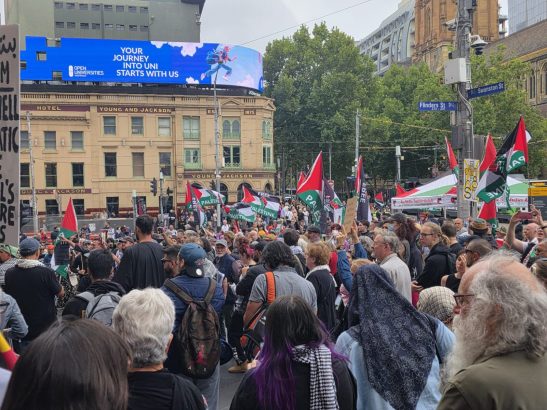
The Council’s Sarah Schwartz went further. Addressing the crowd at a demonstration against the February 2026 condolence visit of Israeli President Isaac Herzog to Australia, she said that after Bondi she was much more concerned with attacks on Muslim Australians. ‘Because of the weaponisation of antisemitism’, she said, ‘a Muslim woman was attacked for wearing a hijab.’ Her comments implied that Australian Jews were exploiting the Bondi Beach massacres and were to blame for anti-Muslim violence.
If all of this were merely rhetorical, it might still be debated. But it is not.
A Faustian Bargain
There are moments when moral failure stops being a matter of misjudgement and becomes a matter of choice. The Council crossed that line when it chose its partners. In a grotesque inversion of history, this organisation has now formally aligned itself with the Hind Rajab Foundation, a body chaired by Dyab Abou Jahjah, a man who has openly declared that Jews in Israel face a choice between ‘the suitcase or the coffin.’ This statement is not metaphor. It is exterminatory language. Abou Jahjah has publicly claimed to have joined Hezbollah and its war against Israel, questioned the existence of Nazi gas chambers, and led organisations fined for Holocaust denial and implicated in violent antisemitic riots in Europe.
A man whose political biography includes membership of Hezbollah, a listed terrorist organisation in Australia (as well as in the United States, U.K, and Germany), praising armed Jew-killing and normalising the vocabulary of annihilation is not a moral outlier that the Council accidentally brushed against.
And what was the joint cause that brought Abou Jahjah and the Council together? Not peace. Not dialogue. Not de-escalation. It was a coordinated legal effort – alongside the Australian National Imams Council – to seek the arrest or exclusion of the sitting President of Israel, Isaac Herzog, from visiting Australia and grieving with Australian Jews.
That is what the Council now calls Jewish ethics. To stand shoulder-to-shoulder with a declared enemy of Israel and the Jewish people, a figure who speaks openly of Jewish extermination, and to do so in the name of human rights. This position is not dissent. It is moral collapse. It is the final form of the Faustian bargain the Council has chosen: approval purchased at the price of solidarity with Jewish enemies, legitimacy purchased at the price of truth, admiration gained by vilifying the Jewish community and an alliance with those who want Jews dead.
As if the physical danger the Council has created for Australian Jews by legitimising those who seek to kill Jews is not enough, the Council has also perfected a rhetorical manoeuvre that is as old as it is cynical: deflection. Re-label Jewish fear as manipulation, then treat the re-labelling as an argument.
Deflecting concerns over antisemitism
When Jews say antisemitism is surging, the Council does not engage with the evidence. It questions their motives. When Jews point to chants, threats, intimidation, and now mass murder, the Council does not confront these phenomena. It deflects and reframes the conversation. The danger is never where Jews say it is. It is somewhere else, somewhere that turns Jewish victims into victimisers.
And in the ultimate act of political deflection, the Council has labelled the Australian Government Royal Commission on Antisemitism and Social Cohesion a ‘McCarthyist’ endeavour. That is not a defence of civil liberties. It is an attempt to intimidate the country into not examining a hatred that has already drawn blood. It suggests that investigating Jew-hatred is more dangerous than the Jew-hatred itself, and turns the investigation of hate into the crime, and the hate itself into an inconvenience.
This is not anti-racism. It is the production of alibis for antisemites.
The pattern is unmistakable. The Council describes Jewish fear as exaggeration. It treats Jewish testimony as suspect. The Council portrays Jewish political agency as morally tainted. And whenever antisemitic language or behaviour becomes too obvious to ignore, the Council rushes to insist that the real danger is ‘conflation’, ‘weaponisation’, or ‘politicisation’.
For the Council, the problem is not the fire. The problem is the people being burned by it.
The ‘Good Jews’
What makes this posture uniquely corrosive is not that that the Council postures about criticising Israel. Many Jews criticise Israel. You do. I do. Israelis do it more loudly and more creatively than anyone on earth. The International Holocaust Remembrance Alliance (IHRA) working definition of antisemitism is explicit in this regard: criticism of Israel like that levelled at any other country is not antisemitism.
But that is not what is happening here.
The Council does is something different: it treats Jewish collective self-defence – moral, political, or psychological – as inherently suspect. It paints Jewish solidarity with other Jews as manipulation. And it regards Jewish vulnerability as a narrative inconvenience. And in an act that smacks of desperation, it made up the names of Jews in a signed petition against Herzog’s visit (and included those who denied they even gave permission), in order to claim it speaks on behalf of a wide cross section of the community.
What can now be termed the anti-Jewish Council of Australia offers the surrounding culture a comforting message: ‘don’t worry – these community-based Jews with their concerns about antisemitism are not the true Jews; we, the good Jews of the Council are the actual representatives of Australian Jewry. The good Jews of the Council will not trouble you with evidence-based claims of exceptional vulnerability. We good Jews will not insist that antisemitism has its own logic. We will not demand that you take Jewish experience on its own terms. We good Jews will translate Jewish pain into universal language, strip it of its particularity, and return it to you in a form that makes no moral demands.’
That is why the Council’s interventions always point in the same direction. When antisemites and terrorists target Jews, the Council’s instinct is not to name the targeting. It is to manage the optics and to deflect. When antisemitic tropes re-enter public life to an extent that the Council cannot deny them, suddenly the Council agrees! There is antisemitism! Then, the Council immediately points the finger at Jewish communal bodies with deflection about how discussion of antisemitism is ‘stopping criticism of Israel’.
Driving their own cudgel into Australian Jews’ open and seeping wounds, this group repeatedly re-labels Jewish alarm as ‘weaponisation’. It then uses that relabelling as a substitute for engaging with the facts of antisemitism. That is why the Council works closely with the far-left Australian Greens political party, and pro-Hamas and Trotskyist advocacy groups to argue that concern about antisemitism is being used to ‘target’ people ‘speaking up’ about Israel, and that claims of widespread antisemitism in protests are a ‘gross misrepresentation.’ And that the Royal Commission is a ‘thinly veiled attempt to silence Palestinian voices’.
That is not an anti-racism strategy. It’s a rhetorical move: deny the scale, question the motive, and relocate the ‘real’ threat elsewhere. It overtly denies the actual experience of Australian Jews.
The Council loves to warn about a ‘conflation of Jews and Israel’, smacking of an inflexible ideological objective because it takes an event that targeted Jews and pivots immediately to conflating Israel and ‘genocide,’ and insinuations about Jews and ‘powerful forces.’ Yet the vast majority of Jews in Australia support the continued existence of the State of Israel, and yet again the Council is at odds with the Jews it claims to speak for.
The core logical failure of the Council’s position is that tells Australian Jews that antisemitism is only real if its fits the Council’s antizionist agenda. The Council’s purpose, unlike genuine communal bodies, it is not to protect Jews. Rather, the Council wants to discipline Jews. The message is: don’t hold up antisemitism as a mirror to society’s failures; don’t understand antisemitism as anti-Jewish, don’t recognise the Jewish right of self-defence, don’t support the Jewish right of self-determination in its historic homeland.
Except, antisemitism is not a misunderstanding. It is not a miscommunication. It is not a tone problem. It is a civilisational pathology that adapts itself to every age, every language, every moral fashion. Sometimes it comes in the language of race. Sometimes in the language of religion. Nowadays in the language of human rights as I recently argued in Fathom.
The Jews who support Israel’s survival, and understand its centrality to Jewish life in a post-Holocaust world, refuse the Council’s discipline. We refuse to believe that survival is purchased by self-denial. We refuse to believe that belonging requires amnesia. We refused to believe that the highest form of Jewish existence is to be harmless to the sensibilities of others.
Every age has its seducers. Every age has Jews who think the price of belonging is to stop insisting on what makes Jews distinct. But after October 7, Pittsburgh, Manchester, Bondi Beach and so many other places, we know with brutal clarity that price is too high.