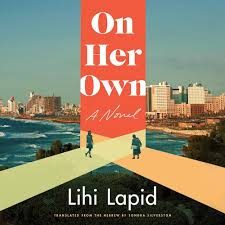

Back in 2022, journalist and author Lihi Lapid signed what Haaretz described at the time as an ‘exceptional’ book deal for an Israeli writer. Harper Via won the right to translate and publish her third novel On Her Own (published in Hebrew the year prior) in English. The Harper Collins imprint found an excellent translator in Sondra Silverston who has previously worked with Etgar Keret and Eshkol Nevo. According to Haaretz ‘the deal was estimated to be worth at least $100,000 and possibly as much as several hundred thousand dollars’.
Lapid began her journalistic career during her military service as a photographer and photo journalist for the IDF’s official publication, Bamahane, which is where she met her husband, Yair, who would, of course, go on to host his own talk show, found a political party, and become prime minister. Her rise through the media industry eventually took her to the Israeli daily Yedioth Ahronoth, where she had a column for 15 years focused on women’s issues – until she was fired in April 2019 following her decision to take time off from writing to campaign for her husband in that year’s election.
As the president of the non-profit SHEKEL, Israel’s leading organization for inclusion of people with disabilities in the community, Lapid is also known as an advocate for those with special needs and their families. Lapid is a mother to an autistic daughter, and the demands and challenges of raising a child with special needs while trying to keep both her marriage and career in journalism afloat all fed into her roman-à-clef I Wanted To Be Wonderful
I desperately wanted to be a good mother, a mother who gave everything she had. Yes, I had also read that there was no such thing as a perfect mother, and a woman had to make do with being a good-enough mother, but I didn’t want to be a good-enough mother. Just like I didn’t want to be a good-enough photographer. I didn’t want to be good enough at anything. I wanted to be a great mother, a charming, wonderful mother, and not just an all-right mother. That wasn’t the reason I had conceived a child. That wasn’t why I had left the professional path. That wasn’t why I had lain in bed for six months. That wasn’t why I had gained all these extra pounds. Not to be average. I had a baby because I wanted to be wonderful.
Originally published in 2013 as Woman of Valour, the book was reissued at the end of last year by Zibby Books (in Hebrew ‘woman of valour’ is Eshet Hayil, the name of a biblical passage men sing to their wives on Shabbat evening). I Wanted To Be Wonderful is half conventional first-person narrative, half fairytale in which the characters are referred to not by their names by their roles such as the prince and the princess – Yair and Lihi, perhaps. The book is more interesting for its insights into Lapid’s life and marriage, womanhood and motherhood, than its literary merits. Lapid has been a popular writer in Israel, her success more commercial than artistic.
Compared to I Wanted To Be Wonderful – which Gafi Amir described in Haaretz as ‘mediocre, full of pathos and suffused with strange mannerisms such as childish symbolism’ – On Her Own is clearly the work of a more mature and serious writer. Her literary instincts are slightly soapy at times, and indeed, the forthcoming TV adaptation of On Her Own has the potential to be successful for that very reason.
But as Amir rightly notes, Lapid takes her themes of ‘immigration, a sense of Israeliness, and belonging against alienation’ and weaves them into her story ‘without waving aside plot and stopping for paragraphs of ruminations, confessions and speeches to the nation. On Her Own is complexly constructed, switching between perspectives from characters who are, in their own ways, alone in or detached from the world to create a well-paced, page-turning story.
On Her Own opens with Nina – the beautiful only child of a single immigrant mother from the former Soviet Union who works as a cleaning lady in a poor development town – fleeing for her safety. Taking refuge in the stairwell of an apartment building on Nordau Boulevard in Tel Aviv, she’s discovered by Carmela, a widow who lives in alone and is sometimes aware of the creeping onset of dementia. One of her sons was killed in military service, while the other, Itamar, lives in the United States.
Carmela takes in Nina, confusing her with her Israeli-American granddaughter, Dana, whom she rarely sees. Her apartment above her old convenience store becomes a place for Nina to hide, as she walks a line between deception and protection as the extent of Carmela’s deterioration becomes ever clearer.
On Her Own’s aforementioned contribution is that it offers insights into parent-child relationships, the fragility of life, and the challenges of immigration and emigration, especially in an Israeli context. Nina is in the grip of a family pathology, behaving with men the way her mother, Irina, did when she was young – or so Irina thinks:
Irina goes into the bathroom and washes her face, looks at herself, remembers how she, like Nina, thought she was so smart, and how she too thought she’d twist them, the men, around her little finger, and she really did. Especially Nina’s father. He loved her so much, but it burned out quickly, so quickly, when she had a belly and wasn’t as happy or beautiful anymore. In the end she found herself somewhere in the middle of a blazing desert, on the second floor, alone with a baby girl. Without a language, without a profession, with a sackful of promises that he took with him to his next woman. And to this day, she’s paying the price for it with her loneliness.
At once, the nature of their lives means that though they are bound by the particular bond of single mother and only child, in some sense, Irina and Nina, first-generation and second-generation Israelis, do not understand one another. Nina is proud of her non-accented Hebrew and doesn’t understand why it’s so important to her mother to use what’s left of her meagre salary to buy tickets to go to the opera or hear the symphony. Irina, thinking about her daughter, is ‘angry about the lack of culture, about her Nina talking in the ugly, disrespectful way those sabras talk’.
As for Carmela, emigration separated her from her family when her son took advantage of a business opportunity and built a new life in the United States. The inherent conflict in Itamar’s marriage to Naama, who grew up on a kibbutz, is the push and pull of home:
Sometimes Naama says about Israelis, ‘Look at how Israeli they are’, when they speak loudly in a restaurant or argue with the guy in Starbucks when he doesn’t understand what they want. And he thinks, yes, they’re Israelis, just as they themselves are. Just as he is. A week ago, two CEOs arrived from Israel for the board meeting, and Itamar took them to lunch with two others from the office. They chattered away about Israeli soccer and cursed the coach and laughed loudly, and instead of being ashamed of them, which he would have been if Naama had been with them, he really enjoyed himself, and for the first time, he didn’t care what the Americans thought of them.
Naama, for her part, while trying to play the role of the American Jewish suburban housewife, ‘still doesn’t really enjoy a book in English. Reading in Hebrew speaks to her heart, her soul. Hebrew passes through her senses and her memories. The smell of pine trees when she reads about woods. The humidity of Tel Aviv. The kibbutz. English has none of that’. The Jewish life of the synagogue and the JCC isn’t hers. In the end, place, memory, and family win the day. America is ‘just another place’, Itamar decides, but Tel Aviv is ‘home’.
On Her Own first landed on bookshelves across the English-speaking world two years after Lapid her megawatt deal with Harper Collins. Unfortunately for her, in the meantime, the world had changed, and the novel fell without hardly making a sound. Outside of English-language Israeli and Jewish publications, ‘On Her Own’ hardly got a review. The paperback edition of On Her Own, published last year, does not carry a single quote from a British national newspaper.
Under normal circumstances, Lapid would have toured with On Her Own, but not a single non-Jewish venue in New York City was willing to host her, according to the author. ‘We were flexible. We offered any hour of the day on any day, whenever they preferred: we just wanted an hour to raise a glass and sign some books. And we couldn’t find any store in Manhattan that would do it’, she told Haaretz, arguing bookstore owners didn’t want the hassle of New Yorkers demonstrating against the presence of an Israeli author.
This shutting out of Israeli authors after October 7 and the Gaza War is ruinous. It denies English-language readers access to the best of Israeli culture, to Israel’s humanistic, introspective side, while isolating and marginalising precisely those who are often Israel’s most pointed and critical voices: its authors. Without the complexities and nuances that Israeli literature provides, all we are left with is caricature: either the village in the jungle on the one side or the génocideur state on the other. Public debate about Israel is greatly diminished without its books and its authors. Above all about the layers of Israeliness, On My Own clearly has something to offer to this discussion, if only it would be heard.