
In this speech – a lightly adapted version of one delivered at a panel about the Middle East and the United States – Brian Morton passionately critiques Students for Justice in Palestine (SJP) and Faculty and Staff for Justice in Palestine (FSJP). A member of the Editorial Board of Dissent Magazine, Morton argues that students should pay heed to the ethics of their conduct and anticipate the political consequences of their advocacy. ‘Don’t find excuses to rationalise atrocities. Don’t dream about a victory that will come in the distant future, after hundreds of thousands of the people you care about have been sacrificed for the cause.’
When we talk about our disagreements, we can sometimes learn from one another; when we avoid them, we’re sure to learn nothing. If I were speaking to an audience that supported Israel’s conduct of the war, I would spend my time tonight talking about why I disagreed with them – why I believe the war has been fought with deliberate and vicious and indefensible cruelty. To any of my fellow Jews who are still trying to justify the conduct of the war, I’ll just ask this: if Iran were doing to Israel what Israel has done to Gaza – if Tel Aviv and Haifa had been reduced to rubble, with three per cent of the population dead (that would be three hundred thousand, in Israel’s case), with thousands suffering from malnutrition, with almost every hospital destroyed, and with almost everyone in the country driven from their homes – how would you regard the people who were trying to find excuses for it? What would you say to try to help them see what was in front of their eyes?
My hunch, though, is that there aren’t too many supporters of Israel’s conduct of the war in the audience. So instead, I want to talk to the members of Students for Justice in Palestine (SJP) and Faculty and Staff for Justice in Palestine (FSJP) who are here tonight. I want to talk about my disagreements with you.
What we’ve needed in this country has been a politically and ethically serious movement aimed at stopping Israel’s destruction of Gaza. I don’t think SJP or FSJP has been either.
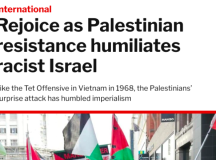
In the days after October 7, 2023, after Hamas fighters killed 1,200 people, most of them civilians, SJP celebrated.The national SJP called it ‘a historic win for the Palestinian resistance.’ They didn’t make a distinction between attacks on military installations and atrocities visited on civilians. In fact, in its Day of Resistance Toolkit, SJP made the weird claim that no one in Israel should be considered a civilian. Later, in the same document, SJP said, ‘All of it is legitimate, and all of it is necessary.’
Ethically, the celebration of October 7 was deeply callous. Politically, it was deeply… what’s a kind word for it? … let’s settle for unthinking. As an American socialist thinker said many years ago, politics is in part the art of anticipating consequences – and what was clear to anyone who knew anything about the current Israeli government, whose key figures include fanatics like Bezalel Smotrich and Itamar Ben-Gvir, people who were already hungering for a pretext to bring about a second Nakba, was that it was going to respond by killing untold numbers of Palestinians.
So when SJP was celebrating the attacks, some of us wanted to ask: even if you’ve found some rationalisation not to care about the young people at the Nova music festival and the grandparents and children who were murdered that day, don’t you see what’s about to happen? Don’t you see that you’re celebrating the imminent destruction of the people you claim to care about? The Lebanese historian Gilbert Achcar recently said that October 7 was ‘the most catastrophic miscalculation in the history of anticolonial struggle.’ Something like that should have been obvious on day one.
As the war went on, many of us hoped that the student movement would give up the apocalyptic posturing and focus on the simple, clear, immediate goal of ending the war. But that’s not what happened.
On the first anniversary of October 7, SJP at our college put up a post saying that the ‘Zionist entity’s existence’ was itself ‘an aggression’, and vowing to continue the struggle against Israel ‘until the roots of evil are extracted from the Arab world and beyond’ – as if disappearing a country of ten million people were an ethical goal.
On the second anniversary of October 7, SJP marked the day with a post that read, ‘Glory to all our martyrs! Revolution until victory!’
‘Revolution until victory!’ After Israel had killed almost 70,000 people, and after thousands of people in Gaza had started to demonstrate in defiance of Hamas, calling for an end to the war – people who just want to live – students at Sarah Lawrence College, in the suburb of Bronxville, weren’t calling for an end to the war, but calling for the battle to continue.
That post was put up not only by SJP but also by our FSJP, Faculty and Staff for Justice in Palestine. Often, they put up the same posts. But one of the surprising features of this moment is that FSJP sometimes goes further than the students do.
A while back, FSJP posted a link to an essay saying that there was no sexual violence on October 7. I know that claims and counterclaims on this question have gone back and forth, but I urge you to read as much of the evidence as you can stomach, not just from The New York Times but from the 2024 United Nations report, and tell me if you think that a reasonable person could conclude, ‘Nope. I’m sure it didn’t happen. It’s all just propaganda. I have no doubt.’ This is the claim that our Faculty and Staff for Justice in Palestine was making.
If you’re an activist, and there’s evidence that the fighters you support have committed atrocities, you need to look at it. You can’t close your eyes. A movement that tells itself fairytales of social justice, according to which our side couldn’t have done anything wrong, is a movement that’s lost its way.
I’m not on this panel because I’m an expert on the Middle East. I’m not that at all. I’m here because I’ve been associated for forty years with the democratic socialist magazine Dissent and I’ve been thinking about radical politics for that long. That’s where I’m coming from when I say that my problem with SJP and FSJP isn’t that they’re too radical. My problem is that they’re not radical enough.
If you’re a serious radical – by which I mean a principled radical – you don’t celebrate war crimes against civilians. You don’t rationalise atrocities. And you don’t support the fanatics on either side.
SJP and FSJP have fallen into the trap of opposing the fanatics on one side by supporting the fanatics on the other.
I’m not saying that the two groups of fanatics are equally powerful. The difference in power is enormous. What I’m saying is that neither group deserves our support.
There’s a paper by a historian named Yoav Di-Capua called ‘Genocidal Mirroring’, in which he writes about how the fanatics within Israel and the fanatics within Palestine have mirrored each other and fed each other and urged each other on. An Israeli settler walks into a mosque and opens fire with a machine gun and kills 29 people and convinces the Palestinian public that they can never make peace with the Jews. Hamas suicide bombers – ‘martyrs’ – blow up people in cafés in Tel Aviv and convince the Israeli Jewish public that they can never make peace with the Palestinians. Together, in their mutual refusal to contemplate any arrangement in which they don’t end up with everything they think God promised them, they work to drive off any possibility of a just peace. Far from being enemies, the two groups of fanatics have been each other’s partners.
It’s easy to recognise a fanatic. Fanatics always dream about total victory. The fanatics of Hamas dream of a land cleansed of Zionists and the fanatics of the Israeli settler movement dream of a land cleansed of Palestinians. And fanatics think that their side is totally in the right. After all, it’s Israel’s fault, because of everything they’ve done since October 7, but it’s Hamas’s fault, because of what they did on October 7, but it’s Israel’s fault, because of the Occupation, but it’s the Palestinians’ fault, because Yasser Arafat turned down Ehud Barak’s peace offer, which might have ended the Occupation, but it’s Israel’s fault, because of the Nakba, but it’s the Palestinians’ fault, because the Arab armies started the 1948 war that led to the Nakba, but it’s the Zionists’ fault, because the 1947 UN Partition Plan that gave half the land to the Zionists was unfair, but it’s the Palestinians’ fault, because they rejected the recommendation of the 1937 Peel Commission, which would have given the Palestinians 78 per cent of the land, but it’s the Zionists’ fault, because the Palestinians were there first, before the British Mandate, but it’s the Palestinians’ fault, because the Jews were there first, thousands of years ago, but it’s the Jews’ fault, because thousands of years ago they took the land away from the Canaanites…
There are only a few ways in which that argument can ever end. It can end with one national group exterminating the other. Or it can end with both peoples living side by side. Not necessarily liking each other, but letting each other live.
I talked about faculty members at our college who aren’t helping, because they’re supporting the fanatics on one side. Now I’ll tell you about a faculty member from many years ago who did better. I’m assuming that many of you have read Rashid Khalidi’s The Hundred Years’ War on Palestine. One of the notable figures in that book is someone who used to teach at Sarah Lawrence. Eqbal Ahmad, a Pakistani militant and intellectual, who had worked with the Front de Libération Nationale (FLN) in Algeria during their revolt against French rule, was a supporter of armed struggle when he thought it could be effective. But in the early 1980s, he visited the PLO leadership in Lebanon and told them that their strategy of armed struggle made no political sense. He said that the PLO simply couldn’t win by fighting that way. He said that in this case the tools of non-violent civil disobedience and the tools of persuasion were the only tools that had a chance of getting anywhere. He saw that the PLO was pursuing a self-defeating strategy, a suicidal strategy, and he urged them to change course. And to the extent that the PLO was able to win anything at all in the next few decades, some tiny measure of self-determination for Palestinians, it was aided, in a small way, by a former Sarah Lawrence teacher who understood that solidarity with a cause didn’t mean taking the side of its fanatics.
Well, we can’t all travel to the Middle East and provide advice about political struggle. What can students do in order to be effective activists?
First: I think you start by reading. Maybe you’ve seen videos of students from this college, just after a demonstration in which they were chanting ‘From the river to the sea’, who, when somebody stepped up to them with a microphone and asked them what river and what sea they were talking about, didn’t have an answer. Don’t be like them. If you care enough about this issue to be marching and chanting slogans, you owe it to yourself to read about it as widely as you can.
Don’t just read the people who reinforce your beliefs. One of the most important things you can do for your development if you want to be a political actor or a political intellectual over the long haul is to read the work of people who challenge your assumptions.
Second: think deeply about your principles.
Principle in politics means holding your allies to the same standards that you demand from your opponents. If it’s wrong for your opponents to murder infants and children and grandparents, it’s wrong for your allies to do it too. Don’t tell yourself that if looked at ‘in context’, the atrocities committed by your side aren’t really atrocities. You’re smarter than that. Don’t insult your own intelligence. If it’s monstrous for Israeli politicians to say that there are no civilians in Gaza – and it is – then it’s equally monstrous for Hamas representatives and the SJP Resistance Toolkit to say that there are no civilians in Israel.
Third: do what you can to support the people who are holding justice and compassion in the same thought.
There are groups of Jews and Palestinians who are working together to try to end the war and who’ve been working together for years to try to end the Occupation. One such group is called Standing Together. They’ve been putting their lives at risk by protecting aid trucks bound for Gaza from the attacks of Israeli settlers and protecting Palestinians in East Jerusalem from settler attacks. Another is called Combatants for Peace – it’s a group consisting of former members of the military on both sides, Israeli and Palestinian, who are now working together to defend Palestinian lives. There’s a publication called +972 Magazine, which is staffed by Jewish and Palestinian journalists who’ve been tireless in exposing the fact that Israel, which has always claimed to have ‘the world’s most moral army’, has been committing war crimes and atrocities in Gaza. Organisations like this are fighting the fanatics. They’re defending the lives of people on the ground. We should do everything we can to support them.
I have more to say about actions we could be taking in this moment, but I don’t want to hog the microphone. I’d love to talk with any student who’d like to talk to me, and explore these questions together, including our disagreements. We’re part of the same academic community, and we should be in conversation. But for now, I’ll end in a more general way.
Don’t find excuses to rationalise atrocities. Don’t dream about a victory that will come in the distant future, after hundreds of thousands of the people you care about have been sacrificed for the cause. Don’t dream of eliminating or driving out an entire population. Don’t make your stand with the fanatics. Make your stand with the people who just want to live.
Palestinians and Israelis each have a deep attachment to the land and a deep sense of belonging there. When we’re thinking about what kind of future is possible, that’s where we need to start.